
 RF: I’ve heard Jimmy Page say that in interviews, too; Scotty Moore was a major influence on a lot of people. What was it about his playing?
Trower: He was a fabulous guitar player. He was inventive, as well, and great sound, great feel. The next great influence was B.B. King and Otis Rush and Hubert Sumlin, Albert King and of course, the big one was Jimi Hendrix, a very great influence.
RF: Did all the Hendrix comparisons help or hurt your career, do you think?  I see it in some ways, but also see you’re such an original on your own.
Trower: I think it clouds the issue. It is a fair comment, but I think it does cloud the issue of what I created myself.
RF: Did “Procol Harum†share a bill with Hendrix, by the way?
Trower: They did before I joined them. I did one show with Procol, and Hendrix was on the bill, but it wasn’t really anything to judge him by; it wasn’t a good night for him.
RF: The Isle of Wight Festival was, I think, the month before he died in September of 1970. With your soloing, how much of it is instinctive? How much  is planned? I mean I’m a frustrated guitar player. I have a guitar signed by Les Paul. So is your soloing some instinctive, some planned? What percentage, would you say?
Trower: I’d say it was 50/50. I sort of got an idea roughly the area I’m going to work in for each song, and it’s sort of whatever happens from there.
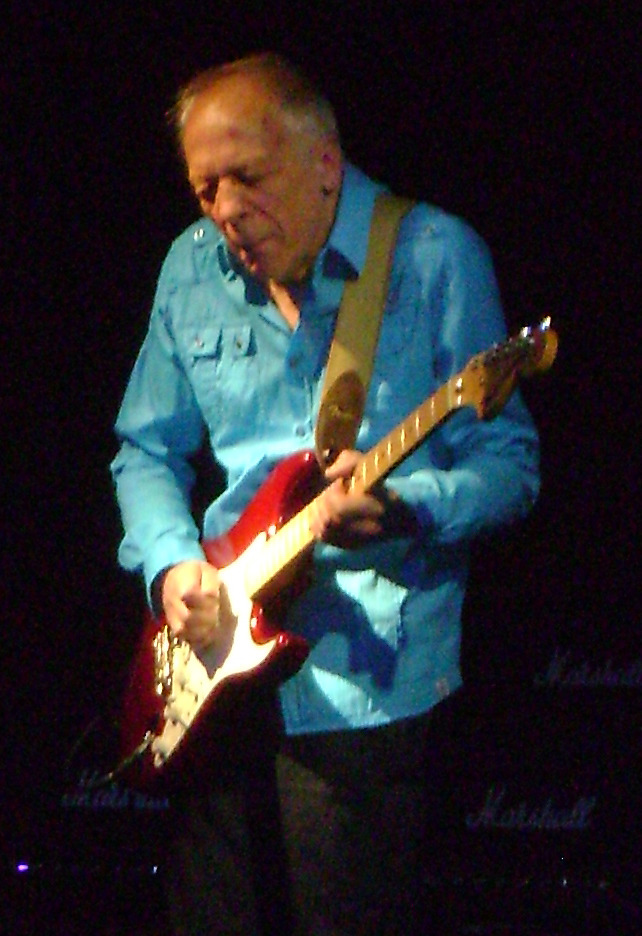
RF: Why is your guitar of choice a  “Stratocaster†most of the time? Am I right about that?
Trower: Oh yeah, I mean that’s basically all I’ve played for 30 odd years, but now the last four or five years – I think six years, it might be, I’ve  used a signature model that Fender makes of mine and they’re sort of made to  my specifications and they just fit the bill perfectly.
RF: Have you played Gibsons in your life?
Trower: When I was in “Procol Harum,†I played Gibsons.
RF: I have a Les Paul Custom, It is such a heavy duty guitar.
Trower: Yeah, backbreaking.
RF: I just wanted to ask you about your writing technique. Is it music first, lyrics to follow, or both?
Trower: Yeah mostly, but I have done it the other way.  On a song called “Another Time, Another Place,â€Â the lyrics came first. There have been two or three that start with a guitar.
RF: If you had to give the Robin Trower of 40 years ago some advice, what would it be? Anything different, do anything different, the same?
Trower: I would probably tell him to look for a better manager.
RF: Could records like BLT be released today with record companies looking for one big hit? To me, the music industry has changed so much in  a negative way. Do you know what I mean? Is there room for creativity and innovation as it was in that golden era of music?
Trower: I do think in the main, you can’t sort of completely generalize, but I do think music has become more formulized, if you know what I mean. And I think people are putting together music to fit into a slot now. You know, “I’m going to do this kind of thing†and I think the consequences of that is that it has become more shallow.
RF: That period through the ‘60s early ‘70s is such a golden age for a lot of English musicians actually. Why do you think so?
Trower: The people in the ‘60s , the British musicians were influenced by the most incredible music that was coming out in America, and that was an incredible era for music so and that can’t happen again. That’s already happened, so now you’ve got people being influenced by music that was influenced by music that was really great music. When you think of the rock and roll era ,for instance, what unbelievable talents were coming out at that time, and you add in some James Brown and Ray Charles. These were the things that inspired the British players and  singers, and  Motown on top of that; unbelievable stuff.
RF: I read an interview once: Paul McCartney saying he would hear standards, he would hear Skiffle, he would hear – like you’re saying – R&B and such incredible influences.
Trower: Very potent stuff.
RF: When you play certain songs now, do the lyrics mean different things to you now than they did?
Trower: No, I don’t think so. It’s never come to mind, that it is.
RF: We were talking about the Shea Stadium. Were there any memorable venues that you played, that gigs or audiences that are just imprinted in your mind like the “Fillmore East†and “Fillmore West?â€
Trower: I remember playing  the Winterland in San Francisco, and having some wonderful nights there.
RF: So your tour goes ‘till October 18th in Fort Lauderdale?
Trower: Yeah.
RF: I actually know some people down there that actually might be going. I was just really impressed when I saw you – fantastic – and it’s been a pleasure.
Trower: Thank you very much.

Leave a Reply